RegMount started as a spearfishing tool. We wanted footage of our hunts, but every mount we tried either took a hand we needed for the gun, pointed somewhere other than where we were looking, or left us wondering halfway through a dive whether the camera was even recording. So we clamped the camera to the one piece of gear that always faces exactly where a diver is looking, the regulator second stage. After three years of testing and ten prototypes, that idea became RegMount. This guide covers what we learned about spearfishing with a camera on scuba: how to mount it, how to set it up, and how to keep the hunt safe, legal and ethical while you film.
Key takeaways
- Spearfishing needs both hands for the gun, the line and the fish, so the camera has to run itself. Mount it hands-free and start recording before you leave the surface.
- A regulator-mounted camera follows your head and eyes, so the shot line, the fish and the follow-through all stay in frame.
- Shoot wide (around 2.7K or 4K at 60 fps with a wide lens), turn on stabilization and horizon leveling, and carry a full battery and an empty card on every dive.
- Regulations change from state to state, between state and federal waters, and from country to country. Many places ban spearfishing on scuba completely. Check the rules before every trip.
- Footage is a record of what you did. Film only legal, clean, ethical takes, and never let the camera push you past your air, depth or no-decompression limits.
Why film your spearfishing dives?
Bragging rights are a fine reason, but the footage is useful for more than that.
- Technique review. Playback shows your approach angle, how close you really were, and how the fish reacted. Most spearos discover they approach too fast, too high or too noisily.
- Shot placement. A clean shot behind the head and above the pectoral fin is humane and stops a fish from tearing off or holing up. Slow motion shows where your shaft actually hit.
- Species and size records. A clear frame of the fish beside your measuring device is a useful record. It doesn’t replace measuring correctly and knowing the rules before you shoot.
- Safety debriefs. Footage shows how long you chased one fish and how often you actually checked your gauges.
The hands-free problem: comparing camera mounts for spearfishing
Recreational divers can get away with a handheld camera. A spearo can’t. One hand runs the gun and the other is busy with the shooting line, the reel, the stringer or a fish that is fighting. Any mount that needs a hand will get dropped, ignored, or turned off at the wrong moment. Here is how the common options compare for hunting. Our full mount comparison covers general diving.
| Mount | Hands-free? | Points where you look? | Spearfishing drawbacks |
|---|---|---|---|
| Handheld / pole / tray | No | Only if you aim it | Competes with the gun for a hand. Easy to drop when a fish is on. |
| Wrist mount | Mostly | No, it points where your arm points | The gun arm is moving and aiming, so the footage swings wildly. |
| Chest mount | Yes | No, it points where your torso faces | Low angle. Arms and the gun often block the lens. Your torso rarely faces the fish when you shoot. |
| Head / mask strap | Yes | Close | You can’t see it, so you never know if it’s recording. It can shift the mask seal, and exhaust bubbles cross the frame. |
| Regulator mount (RegMount) | Yes | Yes, true POV | You need to practice reg-recovery and air-sharing drills with it fitted (see the safety section below). |
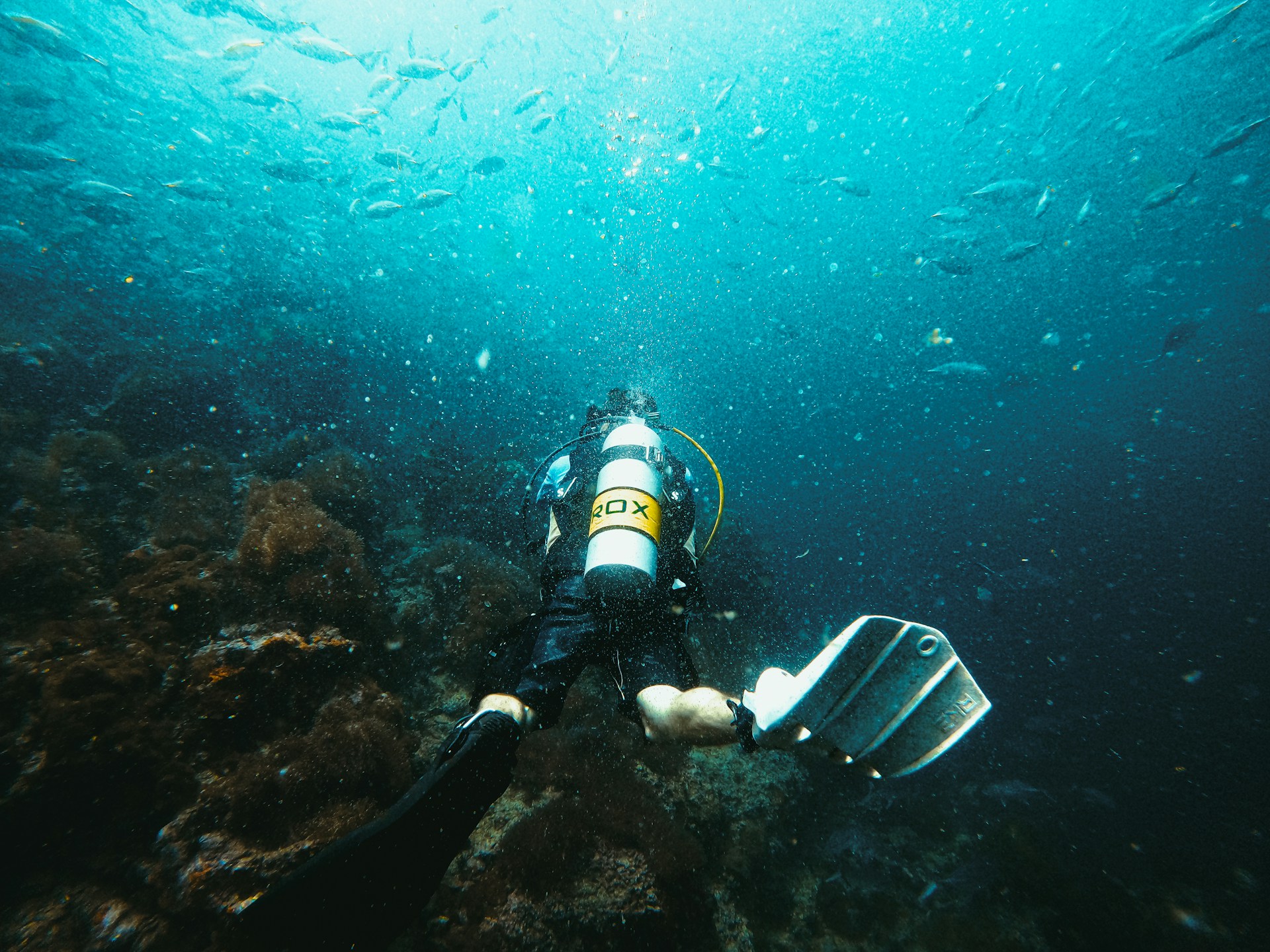
With the camera on the second stage, the lens sits in front of the exhaust, so bubbles don’t drift through the frame. The camera stays in your lower field of view, so a glance tells you whether the recording light is on. The purge button stays fully accessible. When you lock eyes on a fish, the camera is looking at it too.
Setting up your camera for the hunt
Spearfishing footage is mostly quick action at close to medium range, often in water that’s less than ideal. The settings below are a good starting point. Our GoPro settings guide for scuba diving goes deeper.
Resolution and frame rate
Use 2.7K or 4K at 60 fps. Sixty frames per second gives you smooth 2x slow motion for the shot itself. Use 120 fps only in bright, shallow water, because it costs light and battery.
Lens / field of view
Use Wide, or Linear if you want less distortion. A fish 6 to 10 feet away will look small, so don’t zoom in. Get closer instead, which also gives you a cleaner shot.
Stabilization
Turn electronic stabilization on, plus horizon leveling or lock if your camera has it. Head movement during the stalk and the recoil of the gun are both smoothed out.
Color
Below about 15 to 20 feet, use a red filter in blue water or magenta in green water, or lock white balance. See our color correction guide.
Pro tip: Start recording on the boat, just before you put the regulator in your mouth and roll in, and let it run the whole dive. Hunts happen fast, and you won’t get a calm moment to press a button when a fish shows up. A 60 to 75 minute dive at 2.7K fits comfortably on a 128 GB card. Bring a spare battery for the surface interval.
A pre-dive checklist for camera-equipped spearos
Confirm the regulations for the exact location
Check what species are open, the bag and size limits, the closed areas, and whether spearfishing on scuba is allowed at that site. Do this before you load the boat, not while you’re anchored over the reef.
Mount and torque the camera
Seat the RegMount clamp firmly on the second-stage body, thread the camera’s thumb screw tight, and give the camera a firm wiggle. If you’re new to the mount, read the installation and assembly guide first.
Check the housing seal
Look at the door gasket for hair, sand or nicks, close the latch fully, and make sure the lens port is clean.
Breathe the regulator on the surface
Take a few breaths and press the purge. With the chin stabilizer in place, the second stage should sit comfortably without you biting down.
Brief your buddy
Agree on maximum depth, turn pressure, how long anyone can chase a fish, what you’ll do if one of you is out of air with a camera on the reg, and how you’ll handle sharks or barracuda showing interest in your catch.
Safety: the camera never makes the decisions
Spearfishing on scuba already stacks tasks on top of normal diving: tracking a fish, a loaded gun, buoyancy, line handling, gas and depth. Even a hands-free camera adds one more. See our article on task loading and camera gear; the hunting-specific points follow.
Gun handling comes first
- Load the gun underwater, never on the boat or the surface, and keep the muzzle pointed away from divers at all times, including your own fins and your buddy’s back.
- Never point a loaded gun at anyone for a “cool angle.”
- Unload before you ascend, and hand the gun up butt first, unloaded.
Depth, gas and the “one more fish” trap
Chasing a fish down a wall is the classic way spearos blow through planned depth, and wanting the shot makes it worse. Set your turn pressure before the dive and stick to it. Glance at your computer and pressure gauge after every shot, and every time you go after a new fish. Stay within your no-decompression limits and make your safety stop with the same discipline you’d use on any other dive.
Managing your catch
A struggling, bleeding fish attracts predators. Subdue fish quickly and humanely, and keep stringers and catch bags away from your body. If a shark gets persistent, give up the fish. No fish is worth an injury.
Safety first: Never spearfish in caves, under overhangs you can’t see out of, or in any overhead environment. Never let filming change your dive plan. If you’re tired, cold, low on gas or separated from your buddy, end the hunt and surface safely.
Practice air sharing with the camera fitted
If you mount the camera on your primary second stage and your team uses primary donation, the camera goes along with the regulator you hand over. That’s fine as long as both of you expect it and have practiced it. Many spearos mount the camera on whichever second stage they keep in their mouth and run a plain alternate. Some customers also swap the RegMount onto their octopus for selfies or for poking the camera under ledges. Whatever you choose, practice reg recovery and an air-share in calm, shallow water before you take it hunting.
Regulations: know them before you film them
Spearfishing rules depend on where you are, and a video showing an illegal take is evidence. Some general points:
- State versus federal waters. In the U.S., state rules generally cover nearshore waters, and federal rules apply farther offshore. Seasons, size limits and bag limits can differ between the two, and so can the boundary itself. In Florida, start with the Florida Fish and Wildlife Conservation Commission (FWC). For federal waters, see NOAA Fisheries and your regional fishery management council.
- Licenses. Most states require a recreational saltwater fishing license for spearfishing. Some have exemptions, such as targeted programs for invasive species. Confirm what applies to you before you assume anything.
- Protected species. Some species are fully protected and can’t be harvested at all, and others have closed seasons. Know your fish ID well enough to be certain before you pull the trigger.
- Closed areas and gear restrictions. Marine parks, sanctuaries, areas near swimming beaches, piers and jetties, and some counties restrict or ban spearfishing. Some areas allow only certain gear.
- Scuba bans abroad. Many countries and island territories prohibit spearfishing while using scuba, allow it only while freediving, or ban it entirely. The Bahamas, for example, allows spearfishing only on breath-hold. Check before you pack the gun.
Important: This article is general information, not legal advice, and regulations change often, sometimes in the middle of a season. Check the current rules with the responsible agency for the exact area and date of your dive.
Ethics: what your footage says about you
Spearfishing videos shape how the public and regulators see the sport. Good footage shows a selective, skilled hunter. Bad footage gets shared for the wrong reasons.
- Take only what you will eat, and stay well inside the limits rather than right at them.
- Take only clean shots. If the fish is too far away, angled wrong or near a hole it can get into, let it go. Lost and wounded fish are the worst outcome in the sport.
- Don’t shoot for the camera. A shot you wouldn’t take without the camera running is a shot you shouldn’t take with it.
- Respect the reef. Hover, don’t kneel on coral, and keep the shaft out of the reef structure.
- Share responsibly. Don’t post footage of anything you aren’t sure was legal.
Getting better footage of the hunt
Let the approach tell the story
The best spearfishing clips show the whole sequence: you spotting the fish, the slow approach, the shot, and recovering the fish. Because a regulator mount follows your gaze, you don’t need to frame anything. Just look at what matters and hold your head steady for a second or two longer than feels natural. For more on this, see our POV composition tips.
Keep your head still at the moment of the shot
Keep your eyes on the fish at the trigger pull rather than snapping toward the gun. You get the classic POV shot: shaft entering from the bottom of the frame, fish centered.
Built for hunters, by hunters
RegMount was designed for spearfishing first: completely hands-free, low drag, always in view, and aimed where your eyes are. It fits most regulators with a second-stage body of 2 3/8″–3 1/8″ (60–80 mm) and ships free in the U.S.
Spearfishing with a camera: FAQ
Can I use RegMount while freediving for spearfishing?
RegMount clamps to a scuba regulator second stage, so it’s made for spearfishing on scuba where that’s legal. Freedivers don’t breathe from a regulator during the hunt and usually use mask, head or gun-mounted cameras instead.
Will the gun’s recoil knock the camera off the regulator?
Gun recoil goes into your arm and shoulder, not your mouth. A properly tightened clamp and thumb screw hold the camera securely through normal hunting movement. Check the thumb screw before every dive. For extra security, especially for beginners and in current, add a camera tether.
Is spearfishing on scuba legal everywhere?
No. Rules vary by state, by state and federal waters, and by country, and many destinations ban spearfishing on scuba or ban spearfishing entirely. Always check the current rules with the responsible fisheries agency before you dive.
Should I mount the camera on my primary or my octopus?
Most spearos mount it on the second stage they breathe from, because that gives true point-of-view footage. If you donate your primary in an out-of-air situation, brief your buddy that the camera will come with it, and practice that air-share in shallow water first.